Why You Should Delete a Bunch of Your Email Subscribers Right Now

John Ramos • March 16, 2021

Want to run a successful marketing campaign?  Then it’s time to clean house.

You built up your list of subscribers.  Now it’s time to remove a bunch of them.  Because a clean email list can work wonders.


In fact, cleaning your email list can improve three key metrics: deliverability, open rates and click rates. The better these metrics, the more successful your email marketing campaign will be.


That’s because a smaller list of engaged subscribers — people who actively read and interact with your content and brand — are more valuable than a larger list of subscribers who never open your content.

In fact, lists with numerous inactive email addresses typically have higher rates of bounces, spam complaints and unsubscribes than ones that don’t.


Plus, when you continue to send emails to people who don’t open them, internet service providers — like Gmail, Hotmail, and Yahoo — penalize you.  Do this often enough, and your emails may end up in their spam folders, which decreases deliverability to people who actually want to read your content.

Email list hygiene is important

Want to succeed with email marketing?  List cleanup is non-negotiable.


A healthy, well-maintained email list is the foundation for any successful email marketing program.  If you’re spending the time and effort on your campaigns, you want to make sure you get results.


Unfortunately, the average email list depreciates over time – nearly 25% a year.  This is due to a combination of things: bounces, unsubscribes, email address changes.  And if you’re not bringing in subscribers at the same rate as they leave, it can feel like your business is taking a hit.

How often should I clean my email list?

How often you should clean your email list will vary from company to company, and list to list.


But a good rule of thumb is every six months — and definitely not longer than a year.


Or, if you want to keep your list squeaky clean year-round, try cleaning your list every 3 months. 

How to clean your email list

Email list clean up

Ready to say good-bye to inactive subscribers? Clean your list in 5 simple steps.


Step 1: Think quality over quantity

A big list certainly seems impressive.  There are dozens of blog posts and case studies out there touting strategies to go from 0 to 10,000 subscribers in no time.  Not all of these list-building tactics are legit – buying an email list, for example, might get you subscribers, but it won’t get you the results you’re looking for.


Why? Because these subscribers never opted-in to receive your emails.  They don’t know who you are and they most likely have no interest in buying what you’re selling – be prepared for your emails to go straight to the spam folder.  Plus, if you’re using a reputable email service provider [like Constant Contact], purchased lists are totally off limits.

Wouldn’t you rather have a smaller, curated list of ideal subscribers who are super excited to read your emails?  This would certainly bring joy to your email list – and your open rates.


Step 2: Commit yourself to letting go

Letting go of clutter is hard to do.  The same can be said for your subscribers.  Cleaning up your list means having to part with subscribers that you spent time and money to acquire.

Keeping your goal in mind is a great way to stay focused.  Are you sending to attain more sales? Readers? Connections? The people on your list should be the ones who help you achieve that goal.

Keep in mind that not only will a clean list mean more attentive readers, but your deliverability and open rates will improve, too.  Talk about a win-win!


Step 3: Imagine your ideal subscriber

The ideal subscriber is someone who looks forward to seeing your latest newsletter hit their inbox, engages with your newsletters, clicks through to your offers and shares your emails with friends.  While these are the people you want to see on your list, you might find that there are different characteristics and traits among your specific audience.


Having a visual ideal for the type of people you want to send to plays a huge part in how you plan your email strategy.  These personas will make sure your content, cadence and promotional strategy are all in check.

A good way to identify these subscribers is by sending out a survey.  Ask questions about the type of content they’d like to receive and how frequently, as well as what they expect from your emails.  With the feedback you receive, you can learn a lot about your list.


Step 4: Identify your inactive subscribers

Inactive subscribers are people who signed up for your email list, but haven’t opened any of your emails in a long time – or possibly ever.  And we always seem to make excuses for keeping these people on our lists.

There are lots of reasons why these perfectly valid subscribers go dark: they no longer need your products or services; they don’t have time to check all of their emails or maybe they just aren’t interested.  Sometimes people sign up for a one-time incentive offer but have no intentions on purchasing from you again.


Fortunately, your inactive subscribers aren’t too hard to spot. Simply take a look at your subscriber stats to see who opens your emails and who doesn’t.  People who open but don’t click aren’t necessarily a lost cause – they’re showing some interest in your brand, but maybe the content doesn’t completely resonate. It might be a good option to segment them out from those who don’t engage at all, and follow up with more targeted content.


Cleaning up your list from inactive isn’t easy. It’s hard to part with your subscribers! Before you remove these people from your list, try running a reactivation campaign to give them a second chance and increase engagement. If they still aren’t opening your emails, it’s time to let go.


Step 5: Spark some joy

Keep your list healthy and maintained by delighting your subscribers with relevant content. After all, these are your ride-or-die subscribers. You should be showing them as much attention (if not more) than your prospects.


Here are a couple of ideas to possible spark new interest:

  • Send subscribers a special promo code or discount offer
  • Share helpful tips or hacks for using your product or service (bonus points for GIFs)
  • Ask for feedback with a customer survey
  • Reward customers who frequently purchase from you with a loyalty program

But before you delete, try a re-engagement email

campaign first…

Try a re-engagement email campaign to win back inactive subscribers before you clean your email list. It’s a lot less work to reach out to a current subscriber than it is to add a new one.


1. Take a closer look at your inactive subscribers

How did they sign up? If, for instance, they subscribed after signing up for a free eBook or webinar, their interest may have waned after they received their freebie.   Look at the content you covered in the incentive you offered – can you send them similar content again?


2. Segment your list based on activity

Now it’s time to separate the active from the inactive.  As mentioned earlier, you may want to take one extra step by segmenting the totally inactive from the semi-active, or those who have opened your emails but haven’t clicked your links.


3. Reach out to your inactive subscribers


There are a few ways you can do this:


  • Send a survey asking what they’d like to see from you in the future.
  • If you already have an idea of what kind of content they want, send them related content.
  • You can try sending them a freebie – an eBook, checklist or another electronic download – to remind them of your value.
  • For those who have opened your emails but haven’t made a purchase from you, a coupon might be the nudge they need.


For any reactivation message, keep these things in mind:


  • Your message should be super compelling and remind your subscribers why they signed up in the first place.
  • Your value proposition should align with the “What’s in it for me?” rule.
  • Make your subject line pops – remember, these are people who haven’t opened an email from you in a while.
  • Let readers know how they can reach you on other social sites. If a reader checks Facebook more than email, it makes more sense for them to stay in touch with you there.

If the inactive subscribers still aren’t biting, it’s time for a cut-off email

 Send a message to those who were unresponsive to your reactivation email asking them to reconfirm their interest in your mailing list.  Remind them about all the valuable content they’ll miss out on from you.

Remove those inactive subscribers

At this point, you’ve given your inactive subscribers plenty of chances to reconfirm their interest in your list. It’s time to say goodbye!   It might hurt at first, but inactive subscribers can only hurt your email marketing.


Here’s why:

They skew your email analytics in terms of opens rates and click throughs, hurting your deliverability and preventing you from getting an accurate picture of your emails’ success – and that negatively impacts your entire campaign.


You’re better off having a small list of active subscribers than a large list of dead email addresses.


It’s the best way to ensure the overall health of your email list.


Reactivating your inactive subscribers is one of the best ways to reinvigorate your email marketing performance.

If that doesn’t work, it’s time to delete inactive subscribers 

If your inactive subscribers still aren’t biting after a re-engagement campaign, it’s time to say goodbye.

There’s nothing better than the feeling of a clean email list. Have you employed some of these tactics in your email marketing strategy? 

The JR Solutions Blog
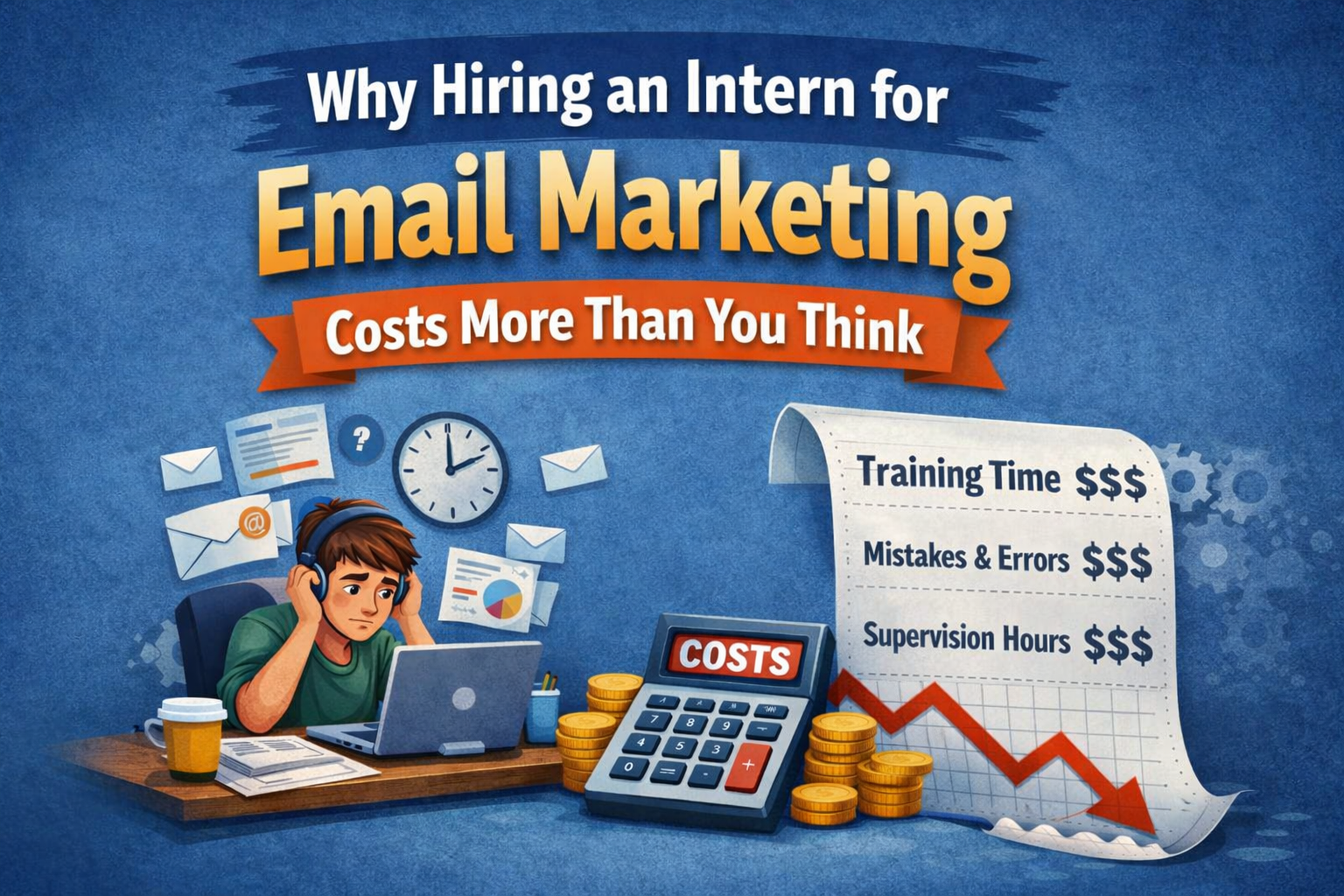
Why Hiring an Intern for Email Marketing Costs More Than You Think
By John R Ramos June 30, 2026
Thinking about hiring an intern to handle your email marketing? Here's the hidden cost most small business owners don't see until it's too late — from a 14-year Constant Contact partner.
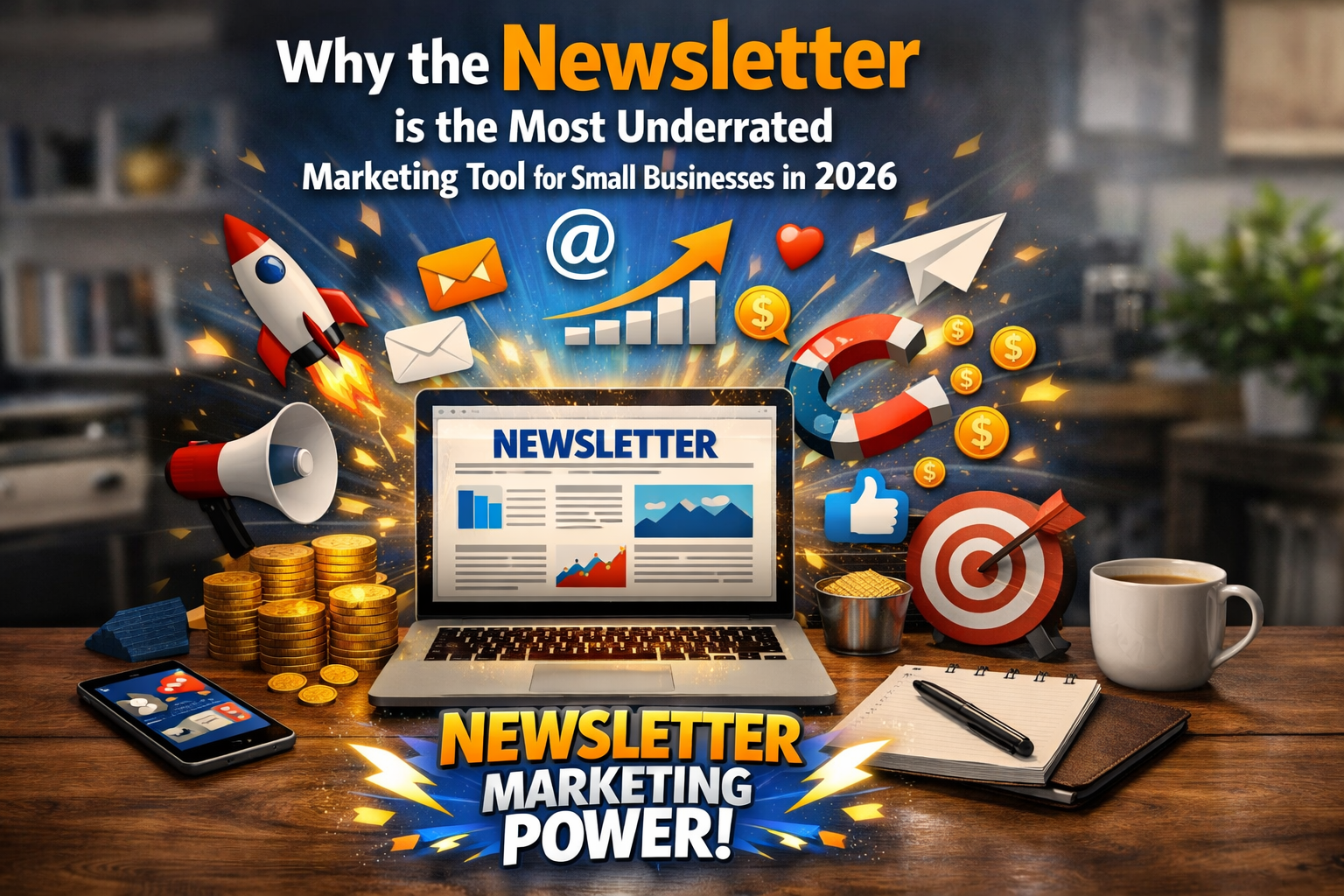
Why the Newsletter is the Most Underrated Marketing Tool a Small Business Has in 2026
By John R Ramos June 12, 2026
Some kinds of email marketing are dying. The newsletter is not one of them. Here's why it's the most underrated tool small businesses have in 2026.
Small business owner reviewing email deliverability metrics on a laptop in Orlando, Florida,
By John R Ramos June 9, 2026
Gmail and Outlook quietly changed the rules in late 2025. Here's why your small business marketing emails may not be arriving — and what to do.
By John R Ramos June 8, 2026
You are sitting at your desk, looking at the monthly numbers, and the thought crosses your mind: maybe email marketing would help the business. Then you look at the budget again and shake your head. “I can't afford it right now.” I have heard those exact words from more small business owners than I can count. And after nearly 14 years working with small businesses across Orlando and Central Florida, I want to share something that might change how you think about that sentence. Almost every time someone tells me they can't afford email marketing, money is not the real reason. That is not a sales line. It is something I have watched play out over and over. The math, when you look at it honestly, almost always says they can afford it. What is actually going on underneath the surface is usually something completely different. And until we name that, the conversation about email marketing for small businesses never goes anywhere useful. So let us look at it together honestly.
By John R Ramos June 2, 2026
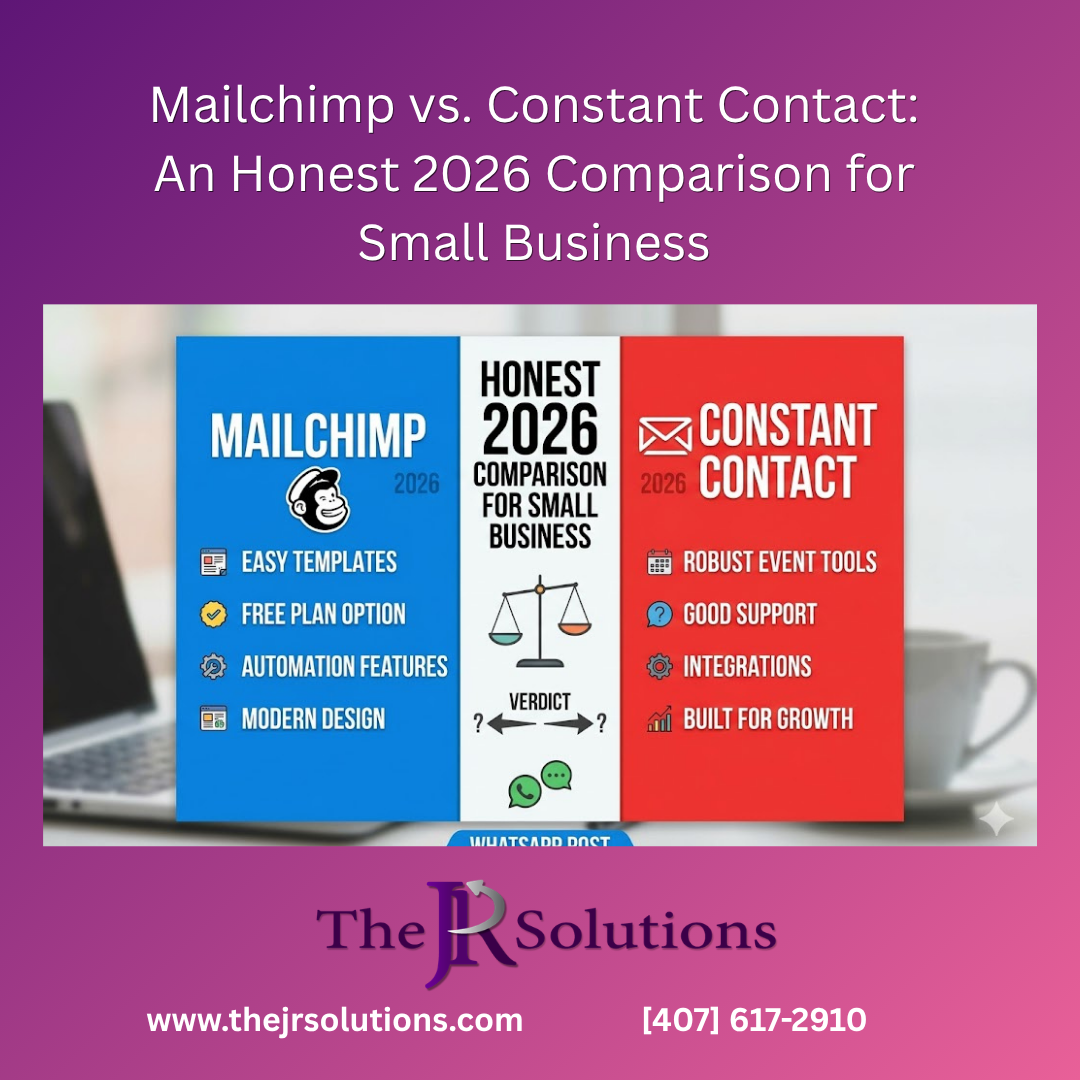
You are trying to choose an email marketing platform, and you keep landing on the same two names: Mailchimp and Constant Contact. Both are huge. Both have been around forever. Both have armies of fans online. And every comparison article you read seems to be quietly trying to sell you one of them. So let me do something different here — starting with the most important disclosure I can make. Full Disclosure Before You Read Another Word I am a Certified Constant Contact Business Partner . That is not a marketing label — it is a designation that requires me to pass a 50-question recertification exam every year on the platform’s latest features and updates, including any new tools they add. If I do not pass, I lose certain privileges. So yes, I have a professional relationship with Constant Contact, and yes, that relationship is earned and renewed annually, not free. I also have not personally used Mailchimp. What I know about Mailchimp comes from people who use it, from clients who have shared their experiences, and from Mailchimp’s own publicly published pricing pages and feature lists. I am telling you this up front because most comparison articles fake firsthand experience with both products. I would rather you know exactly where I sit and exactly what kind of source I am, so you can weigh everything that follows accordingly. Now, let us get into it. The Honest Headline: Both Platforms Are Real, and One of Them Has Been Quietly Changing Let me give you the fair version up front. Mailchimp is a real platform with real strengths. It is well-known, the interface is polished, the brand is famous, and at the very entry level, it is competitive on sticker price. Constant Contact is also a real platform with real strengths. It has been around since 1995, it focuses heavily on small business users, and the support model is genuinely different from most of the industry. Either one can work. The honest question is not “which one is better.” It is “which one is built for the kind of small business owner you actually are, in 2026?” To answer that, you have to look past the homepages and at what is actually happening with each platform. Where Mailchimp Has Been Headed (And Why It Matters) There is a story in Mailchimp’s pricing history that most comparison articles will not tell you, but it is the most important context I can give you. In 2021, Mailchimp was acquired by Intuit — the company behind QuickBooks and TurboTax — for $12 billion. Since that acquisition, here is what has happened publicly to Mailchimp’s pricing and free tier, by year: • In 2022, the free plan allowed up to 2,000 contacts. • By 2023, the free plan was reduced to 500 contacts. • As of 2026, the free plan caps at 250 contacts and 500 sends per month. • Paid plan prices have increased roughly 20–30% between 2022 and 2024. • Legacy account holders received an additional 11–13% increase in April 2026. That is an 87.5% reduction in the free plan in four years, plus paid increases on top. None of that is opinion — it is documented in Mailchimp’s own published pricing changes over time. The takeaway is not “Mailchimp is bad.” The takeaway is that Mailchimp’s business has been steadily moving upmarket since 2021 . They are increasingly built for larger enterprise customers, and the small business owner — you — is no longer the audience they are optimizing for. That is a fair observation about a company’s direction. And it is worth knowing before you sign up for a platform you plan to grow with. Sticker Price vs. Real Price: The Honest Money Comparison Here is where comparison articles usually get sneaky. They compare the lowest possible price of one platform to a higher tier of the other, and pretend that is apples to apples. Let me give it to you straight. At the entry level (500 contacts), the two are nearly identical on sticker price: • Mailchimp Essentials: about $13 per month • Constant Contact Lite: about $12 per month A dollar a month apart. Anyone telling you Constant Contact is wildly cheaper at this tier is not being straight with you. They are essentially the same starting price. The real difference shows up when you ask: “What am I actually getting for that dollar?” This is where the platforms diverge in ways that matter — and where the sticker price stops being the real price. Support: The Difference People Underestimate Until They Need It If there is one area where these two platforms are not even close, it is here. And this is the part where, from talking to Mailchimp users over the years, I have seen the most genuine frustration. Mailchimp: email support, often slow Mailchimp’s lower tiers do not include live phone support. When something goes wrong — your email did not send, your list will not import, your automation is misfiring, the deadline is today — your option is to email their support team and wait. People I know who use Mailchimp have told me that wait times can run up to three days before they hear back. Mailchimp does offer 24/7 chat and email support on paid plans, and faster priority support on the highest tier. But phone-based human assistance is not part of the standard small-business experience. The pattern I have heard from Mailchimp users, almost universally, is this: they have learned to find workarounds for problems rather than getting them solved. That is a real skill. It is also a tax — a hidden one paid in your time, your stress, and your missed deadlines. Constant Contact: free live phone support, six days a week Constant Contact includes free phone support six days a week on every paid plan. You can call as many times as you need, at no extra charge. A real human picks up, listens to your problem, and helps you fix it. That is genuinely unusual in this industry. Most platforms have offloaded customer support to chatbots and articles. Constant Contact has kept the phones open. And one more thing about support, if you go this route: as a Certified Constant Contact Business Partner, you can also call me for free. As many times as you need. No retainer, no clock running. That is just what I do. If you are a small business owner who handles a hundred things at once, the difference between “wait three days for an email reply” and “dial a number and get a person” is not a small detail. It is the difference between marketing that runs and marketing that stalls. Three Hidden Cost Patterns to Watch For Beyond sticker price, here are three ways the real bill can be higher than the marketing page suggests — things every small business owner deserves to know before committing. 1. You may pay for contacts who do not want your emails On Mailchimp, your bill is based on your total contact count — which includes unsubscribed contacts still sitting in your account. In other words, you can pay every month for people who have already told you they do not want to hear from you. That has caught many small business owners off guard, and according to independent pricing analyses, this single quirk can inflate actual bills by 20–40% above what the pricing page advertises. Constant Contact handles this differently. When a contact unsubscribes, the platform actively recommends removing them from your list so you stop paying for them. It is also one of the first things I tell my clients to do, because there is a bigger reason beyond billing: keeping unsubscribers on your list quietly hurts your deliverability. Email providers like Gmail and Outlook watch how recipients engage with your mail. A clean, engaged list lands in inboxes. A bloated list with disengaged contacts gets pushed to spam. So, removing unsubscribes saves you money and helps your future emails actually reach the people who want them. That is the kind of small detail you only learn from someone who works inside the platform every day. 2. The free plan is more limited than it looks Mailchimp’s free plan caps at 250 contacts and 500 monthly sends, with Mailchimp branding on every email and no multi-step automation. For a real small business trying to actually grow, that is more of a sampler than a usable plan. It is fine to learn on. It is not a place to run a business from. Constant Contact does not offer a forever-free plan. What it offers instead is a 30-day free trial with no credit card required , where you can load up to 100 contacts and test all of the features at full strength. Different model: trial then commit, versus stay-free-but-stuck-small. Which is better depends on what you actually want. 3. Add-on features stack up Both platforms charge extra for some features (text message marketing, advanced previews, transactional emails). That is normal. But before you commit to either, read the fine print and ask yourself which add-ons you will actually need so the comparison is honest. A Quick Side-by-Side, the Honest Way Pricing at 500 contacts: • Mailchimp Essentials: about $13/month • Constant Contact Lite: about $12/month — nearly identical Free option: • Mailchimp: forever-free at 250 contacts with branding and limited features • Constant Contact: 30-day free trial with full features, no credit card required, up to 100 contacts Phone support: • Mailchimp: not standard — email and chat, with potential multi-day waits • Constant Contact: free phone support six days a week on every paid plan Email send limits: • Mailchimp: tied to contact tier • Constant Contact: no daily send cap (though just because you can send daily does not mean you should — your subscribers will tire of it fast) Contact billing on unsubscribers: • Mailchimp: bills you based on total contacts, including unsubscribers still in your account • Constant Contact: actively recommends removing unsubscribed contacts, so you do not pay for people who no longer want your emails — and your deliverability improves as a bonus Direction of the business: • Mailchimp: moving upmarket since the 2021 Intuit acquisition • Constant Contact: still small-business-focused since 1995 So Which One Is Right for You? Here is the honest answer, the kind I would give a friend over coffee: Mailchimp might be fine for you if… • You are comfortable with technology and prefer figuring things out on your own. • You are okay waiting on email-based support when something breaks. • You have a tiny contact list and just want to play with the basics for free. • You do not mind paying for unsubscribed contacts as your list grows. Constant Contact is probably better for you if… • You want to call a real human when you have a question — and you do not want to pay extra for that privilege. • You value time saved more than $1 a month saved. • You want a platform that has stayed focused on small businesses since 1995. • You like the idea of being able to call your Certified Business Partner directly when you are stuck. Most of the small business owners I work with in Central Florida fit the second list. If you are honest with yourself about how much time you actually have to troubleshoot a platform versus how much you want to spend running your business, you probably fit the second list, too. So, Where Does This Leave You? Here is the honest pattern I have seen over and over with the small business owners I talk to in Central Florida. The decision is rarely really about Mailchimp versus Constant Contact. It is about a deeper question: Do you have the time and energy to run email marketing yourself — troubleshoot a platform, write the campaigns, manage the list, learn the analytics — or would you rather have someone handle it for you while you focus on running your business? Both answers are legitimate. Here is what each one looks like . If you would rather have it handled for you This is what most small business owners I work with ultimately choose, once they do the honest math on what their time is worth. When you work with me, you get a Certified Constant Contact Business Partner running your email marketing end-to-end. That means strategy, writing, design, scheduling, list management, troubleshooting — all of it — for one steady monthly fee. The platform is handled. The support questions never reach you. You focus on your business; I focus on the marketing function. I call this your external marketing department , and for most small businesses, the time you get back is worth more than the fee. Email me at john@thejrsolutions.com or call 407-617-2910 for a free 30-minute consultation. No pressure, no jargon, no pixie dust — If you would rather have it handled for you. If you want to see exactly how my services and pricing work, the honest pricing guide breaks it all down . And if you are still weighing whether to hire an agency, a consultant, or do it yourself, this honest comparison may help you decide . If you would rather run it yourself Some small business owners have the time and the interest to handle their own email marketing. If that is you, do not let anyone talk you out of it. The DIY path can work, especially if you start with the right platform and use the support it offers. You can start your 30-day free Constant Contact trial here — no credit card required, up to 100 contacts, full features. As a Certified Constant Contact Business Partner, I earn a commission if you sign up through that link, which is the disclosure I made at the top of this article. Whether or not you ever hire me, you can call me for free if you get stuck along the way. That offer is open to anyone who signs up through that link. The worst move is staying stuck because you cannot decide. Either path — hiring help or starting yourself — beats doing nothing. The trick is starting.
By John R Ramos May 29, 2026
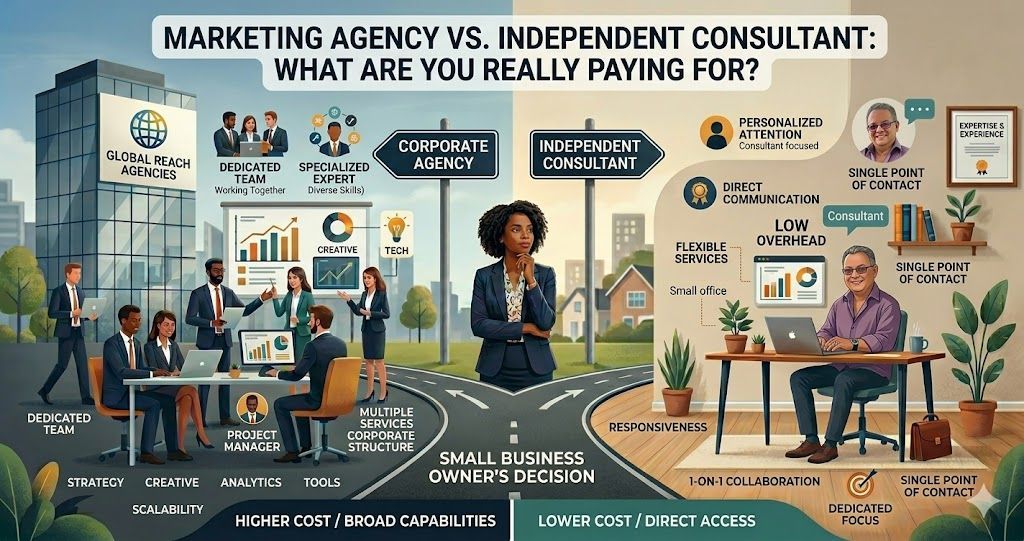
You walked out of that pitch meeting feeling two things at the same time: impressed and uneasy. The agency had a polished website, a slick deck, a team of people with titles, and a monthly number that made your stomach drop a little. They threw around words like “omnichannel,” “funnel optimization,” and “brand ecosystem.” You nodded. You did not want to look uninformed. But on the drive home, the quiet voice in the back of your head asked the only question that really matters: What exactly am I paying for? That is the right question. And almost nobody in this industry will answer it honestly, because the honest answer costs them business.  So let us do it here. No pixie dust, no jargon, no pretending. After nearly 14 years working with small businesses in Central Florida, I am going to walk you through what an agency actually delivers, what an independent consultant actually delivers, where each one is genuinely worth the money, and how to spot the difference between a real expert and someone selling you fancy words.
By John R Ramos May 22, 2026
Let me guess. You know email marketing could help your business, but every time you start looking into it, you hit the same wall: nobody will give you a straight answer on what it actually costs. One site says it is “affordable.” Another says, “It depends.” A third wants your email address before they will tell you anything. Meanwhile, you are a busy small-business owner in Orlando, just trying to figure out whether this fits your budget. So let me do something different here. I am going to give you real numbers. No runaround. No “contact us for a quote” wall. Just an honest breakdown of what email marketing costs in 2026, whether you do it yourself or hire someone to do it for you — so you can make a smart decision for your business.
By John R Ramos April 27, 2026
Running a business today is not easy. Between serving customers, managing operations, keeping up with technology, staying active online, and trying to stand out in a crowded market, most small business owners are carrying more than they should. And the truth is, your competition may already have helped. Some of them may have an internal marketing team. Others may be working with a digital marketing partner who helps them stay visible, communicate consistently, and keep their brand in front of the right people. That does not mean they are better than you. It may simply mean they are not trying to do everything alone. For many small and medium-sized businesses, marketing becomes one of those things that gets pushed to the side. Not because it is unimportant, but because there are only so many hours in the day. You know you need to post on social media. You know your website should stay fresh. You know email marketing can help you stay connected. You know content matters. You know follow-up matters. But knowing what needs to be done and having the time, skill, and consistency to do it are two very different things. That is where having a digital partner can make a real difference. A good digital partner is not just someone who “does marketing.” A good digital partner helps you think through your message, your audience, your communication strategy, and the systems that keep your business visible. Think of it this way. Trying to grow your business online without direction is like sailing across the ocean without a compass, a map, or a clear destination. You may still move, but you may not be moving in the right direction. A digital partner helps you navigate. They help you clarify your message, create useful content, communicate with your audience, and stay consistent in a business environment that keeps changing.
By John R Ramos March 19, 2026
Let’s be real for a minute. The hustle on social media is exhausting. We all do it. We spend time crafting the perfect post for Facebook, we find the right sounds for a Reel on Instagram, and we jump into groups, trying to show up, be useful, and get seen. And when we get a post that takes off, when the "likes" and comments start rolling in, it feels good. It feels like progress. But I have a hard question for you (and it’s one I had to ask myself not too long ago): If your favorite social media platform disappeared tomorrow, how would you reach those people again? 😰 If your answer is a long silence or a spike in anxiety, you aren’t alone. But it means you are building your business on "rented land."
By John R Ramos October 27, 2025
IYou’ve likely seen them: bold visuals, stacked icons, concise text, telling a story at a glance. That’s an “infographic “—but in 2025, it’s more than just a pretty picture. For small-to-medium-sized businesses ready to stand out in a noisy marketplace, infographics remain a potent tool—if used strategically.